
A 50% Tariff vs. 1.4 Billion People: Who Will Blink First in the 2025 U.S.-India Standoff?
In August 2025, the relationship between the world's two largest democracies, the United States and India, faced a major crisis. The U.S. government imposed a staggering 50% tariff on a wide range of Indian goods. This was not a minor policy adjustment; it was a significant act of economic pressure. The impact was immediate and severe. The United States is India's largest trading partner, and according to trade analysis data, Indian exports to the U.S. collapsed as a result of the tariffs. Between May and September 2025, shipments dropped by a catastrophic 37.5%.
In industrial centers across India, known for textiles, leather goods, and jewelry, order books dried up. These sectors employ millions of people, and the 50% tariff made their products unaffordable for American buyers. The U.S. government stated that the tariffs were a "penalty" for India's continued purchase of large amounts of oil from Russia, which Washington argued was "aiding Russia's war effort" in Ukraine. India’s government responded publicly, calling the tariffs "unfair, unjustified, and unreasonable." While the situation appeared chaotic and emotional, fueled by heated headlines and conflicting personalities, beneath the surface, the actions of both countries highlighted the stark realities of global power dynamics.
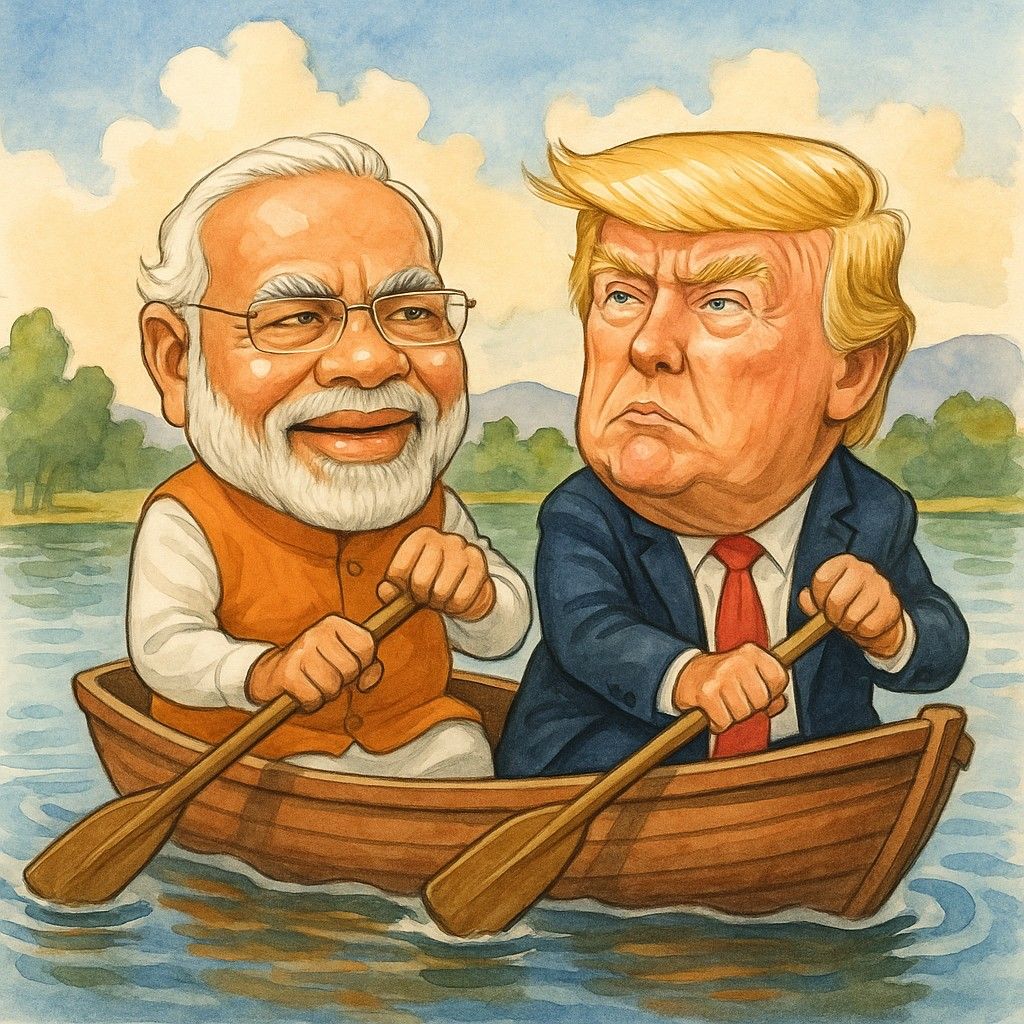
The Game
In the 1980s, political scientist Robert Axelrod conducted the famous computer tournament to identify the best strategy for an "indefinite game"—a game played repeatedly without a defined end, similar to geopolitics. Axelrod invited expert game theorists, economists, and computer scientists to submit strategies to compete. He received a wide range of entries, from the extremely simplistic to highly complex programs designed to analyze and exploit an opponent's history. Surprisingly, the winning entry was not one of the intricate programs; instead, it was one of the simplest: the 'Tit-for-Tat' strategy. This winning strategy operated on an "eye-for-an-eye" principle but also included an essential rule: forgiveness.
To understand this game that all nations engage in, let's simplify things. Instead of delving into complex geopolitics, imagine two people in a single rowboat in the middle of a large lake. Both aim to reach the shore, which represents a "Win" for both of them.
If they both row, the boat moves quickly, and they both reach the shore in no time. This is the best possible outcome for both. However, if one person decides to "defect" by taking her oars out of the water to rest, she forces the other to do all the work. The boat will still move, but slowly. The person who defected hopes to gain a selfish win by getting a free ride, forcing the other person to do all the work, only to achieve a delayed, worse outcome. Seeing this, the other person may also decide to defect and stop rowing. Now, neither of them is rowing, and the boat becomes dead in the water. They are both stranded, resulting in a "Lose-Lose" situation. Ideally, the best way to get the boat moving again is for the first person who defected to "cooperate" and start rowing again. As soon as that happens, the retaliator must immediately forgive the previous defection and start rowing as well, so they can return to a "Win-Win" state.
Before moving on, there is one last critical question to consider: “Is retaliation affordable?”
When the second rower retaliates by stopping her rowing, she realizes that doing so will cause the boat to come to a halt. By making this choice, she is intentionally putting herself in a "Lose-Lose" situation to punish the other person and demonstrate that "defecting" has consequences. However, this act of retaliation comes at a cost. The crucial question is: Can she afford to be stranded?
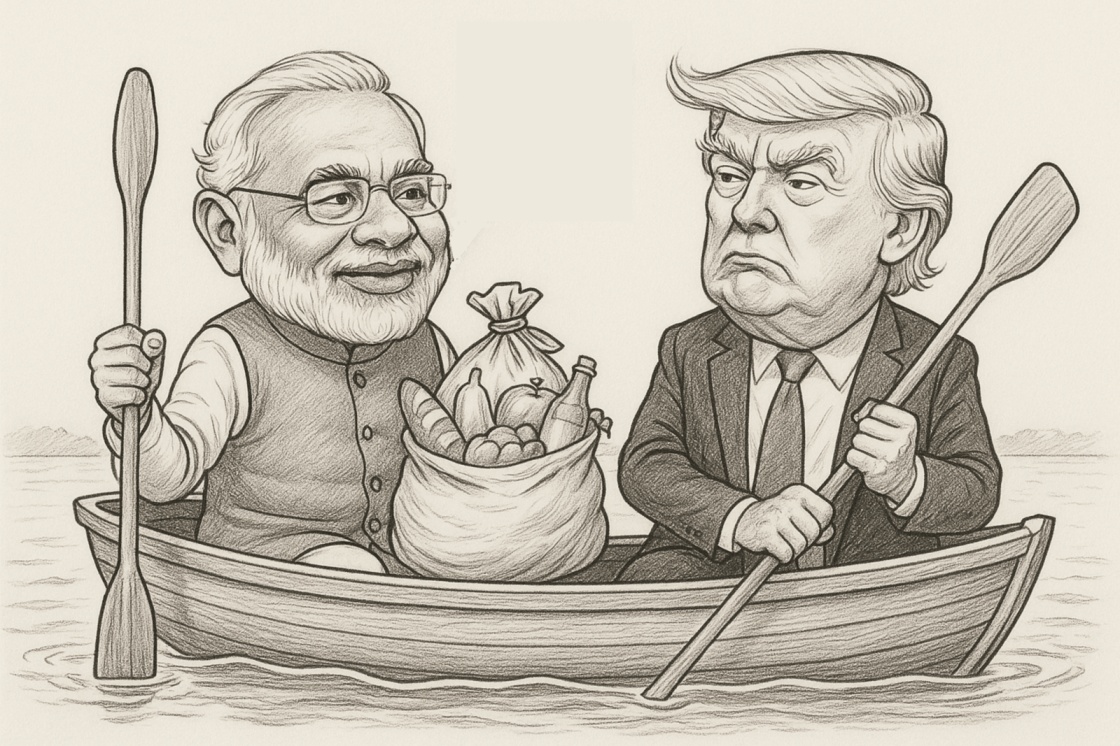
This is where "affordability," or economic resilience, becomes a pivotal factor in the geopolitical game. Imagine that the retaliator has wisely packed a backpack full of food and water, while the defector has brought nothing. The retaliator possesses "affordability," which allows her to survive being stranded in this "Lose-Lose" state for an extended period. Because she has this "shock absorber" (the backpack), she can afford to keep her oars out of the water.
Eventually, the defector’s hunger and thirst (economic pain) will become overwhelming, forcing her to cooperate first and resume rowing. Ultimately, the player with the largest backpack—those who can best endure the costs of the "Lose-Lose" standoff—will always be triumphant.
The Defection: America Pulls Its Oars
The current crisis began when the U.S. pulled its oars out of the water with the 50% tariff. It was an aggressive, hostile move designed to inflict immediate and severe pain on India's economy. The justification for this move reveals the true motives behind it. The U.S. administration claimed that half of the imposed tariff was a "reciprocal" tax, serving as retaliation for India’s unfairly high taxes on U.S. goods. The second half of the tariff was a response to India's "defecting" by purchasing Russian oil.
However, the critical aspect to consider is that, in "Tit-for-Tat" terms, both justifications represented a "defection." The previous agreement—India's existing tariffs and its policy on oil purchases—constituted a "Cooperate" state. By unilaterally imposing new punitive tariffs to force a change, the U.S. was the one that stopped cooperating. It became the first player to "defect,". The aspect of "Russian oil" in this defection is particularly significant. From 2022 to 2024, U.S. officials, including Treasury Secretary Janet Yellen, publicly expressed that they were "happy" with India's purchase of Russian oil. This was viewed as a means to stabilize global energy markets and prevent a price spike. This indicates that the U.S. did not merely defect; it also retroactively changed the rules, reclassifying a previously encouraged action as a punishable offense.
In November 2025, the situation became even more confusing when the U.S. administration met with China at the APEC summit and agreed to a "truce" in their trade war. This agreement resulted in lower tariffs on many Chinese goods. As a consequence, India found itself in an awkward and insulting position: it was now facing a higher tariff rate of 50% compared to China's 47%. Despite being considered a "strategic ally," India was being treated worse than its primary geopolitical rival.
It seems reasonable to conclude that the U.S. believed its "selfish move" would deliver a decisive blow. The 37.5% drop in exports, along with strategic and security concerns in the region, would likely be so painful that they assumed India would have no choice but to capitulate to U.S. demands immediately. They probably expected to achieve a quick and easy victory.
India’s Quiet Counterstroke: The Pivot and the Backpack
Following the optimum strategy of the game, India needed to make a counter-move. It could not simply "cooperate" and allow itself to be taken advantage of, as that would likely lead to more selfish actions from the U.S. in the future. However, India seems to be playing a clever, long-term strategy. Instead of implementing a straightforward "eye-for-an-eye" counter-tariff, which would mean imposing a 50% tariff on U.S. goods, India recognized that this approach would only entrench both sides in a "lose-lose" scenario, ultimately harming Indian consumers with higher prices. Instead, India opted for a quieter, more patient, and ultimately more effective "asymmetrical" counter-move. India, in effect, pulled its oars out of the water and revealed its backpack.
This counter-move consists of two parts.
First, India has a significant advantage: "a backpack." The U.S. anticipated that a 37.5% drop in exports would have a severe impact on India. However, India's economy differs from that of other export-oriented countries. A crucial fact is that its vast internal market of 1.4 billion people constitutes nearly 60% of the economy. This internal market acts as India's "backpack," serving as a substantial "shock absorber." While the export sector faces significant challenges, the overall economy can endure these difficulties, providing the Indian government with a vital asset: patience.
Second, India has made a strategic "pivot." This represents a genuine "Tit-for-Tat" response. While the U.S. concentrated on inflicting short-term pain, India started to quietly and significantly alter its long-term strategy. It is moving away from its dependence on the U.S. market. Evidence of this shift is already apparent, as trade between India and the U.S. plummeted in 2025, while India's trade with the European Union increased by 15% in the third quarter of 2025. India is actively pursuing new trade agreements with the Middle East, including countries like the United Arab Emirates, and other partners.
The reasoning is clear: if the U.S. market becomes too hostile and expensive, India will shift its goods to other willing buyers, showcasing a strategic move. This reflects a calm, logical, and long-term diversification of trade relationships, which could lessen U.S. influence and disrupt supply chains even after the 50% tariff is lifted. It's important to note that this "strategic pivot" wasn't a spontaneous reaction but rather the activation of a multi-year contingency plan. The U.S. tariffs provided India with the urgency to implement its existing strategy swiftly: India's "backpack" was already packed.
The Stranded Boat: Who Can Afford to Sit Still?
This brings us to the "boat is stranded" moment. We are in the "Lose-Lose" state. Both economies are now being hurt. Both rowers are sitting with their oars in the boat, staring at each other. The standoff is now purely a question of "affordability." Who can afford to be stranded the longest? As we've seen, India’s "backpack" is full. Its massive domestic market, accounting for nearly 60% of its economy, acts as a powerful "shock absorber." It gives India the ability to afford the short-term, acute pain to its exporters (the 37.5% crash) in order to enforce the "rules" of the game and teach the U.S. a long-term lesson.
The U.S. also has a large domestic market. However, its "cost" for this standoff is different and, based on the facts of 2025, far more immediate and strategically perilous. The U.S. "backpack" is being drained by three self-inflicted wounds. First, the increased tariff on Indian imports contradicts the U.S. strategy to shift supply chains away from China, making it harder for companies like Apple to operate in India. Second, the recent trade "truce" with China, which lowers tariffs to 47%, creates a scenario where the U.S. penalizes an ally with higher tariffs than the primary adversary, thereby undermining trust with its other allies. Third, the tariffs restrict U.S. access to India's large market, hindering a crucial political priority. Additionally, the U.S. government's contradictory behavior is evident in the fact that very recently, U.S. and Indian defense officials signed a new 10-year Defense Framework Agreement.
This is the real standoff: India is betting its "backpack" (a self-reliant domestic market) is fuller than America's "backpack," which is now being emptied by immediate corporate pain, political humiliation, and the strategic failure to deliver a "win" for its own key voters.
The Red Line: Why Agriculture Is the Real Dealbreaker
The U.S. has proposed a way out of the current "Lose-Lose" situation, but it's a complex offer. During the trade talks that resumed in the fall of 2025, the U.S. made a statement that implied, "We will begin cooperating again if you agree to give us half of the food in your backpack." This has led to a deadlock. The U.S. is willing to eliminate the 50% tariffs only if India consents to an additional, unrelated demand: fully opening its agriculture and dairy markets to U.S. companies. This would also include permitting U.S. genetically modified (GM) crops.
For the Indian government, the demand being made is an absolute "red line." Accepting it would be akin to political suicide, as India’s agricultural sector is vastly different from that of the United States. It consists of hundreds of millions of small, often impoverished farmers, whereas U.S. agriculture operates as a highly efficient industrial machine. Allowing U.S. agribusiness and genetically modified (GM) crops to flood the Indian market, as some analyses suggest, would jeopardize the livelihoods of millions of these farmers and could trigger massive, nationwide protests.
Consequently, India cannot accept the U.S. offer. Meanwhile, the U.S. is unwilling to lift its tariffs without securing a "win" that it can present to its own farm-state voters. The situation is at a standstill: the U.S. is demanding that India take the first step, but India has refused, confident that it can outwait the United States.
Endgame Watch: A Mini-Deal or a 2026 Stalemate?
The current "Lose-Lose" situation is unsustainable and harmful to both the U.S. and Indian economies. The most logical outcome is a return to a "Win-Win" scenario, where both countries cooperate. However, neither leadership can afford to appear as though they are "losing" to their domestic audiences. The U.S. requires a victory for its farming lobby, while India must be seen as having protected its farmers.
Given these pressures, we can reasonably infer a logical path out of this deadlock. This is not a prediction, but simply a "what to watch for" based on the logic of the game.
The most rational solution is a "mini-deal" that cleverly re-frames the entire situation, allowing both leaderships to declare a total victory. In this scenario, the U.S. would "blink" first, but in a face-saving way. It would agree to de-link the tariffs from the impossible demand on agriculture. In return, India would "forgive" this move and offer the U.S. a different kind of "win"—a large, headline-grabbing purchase that the U.S. can take home as a trophy. This could be a multi-billion-dollar deal for U.S. defense equipment (such as jets or drones) or a massive new contract to purchase U.S. corn, specifically for India's ethanol biofuel Program. This would be a clever loophole, as it would appease the U.S. farm lobby without breaking India's "GM food" red line.
This represents the logical endgame. It's not about one side defeating the other. It's about two powerful players, caught in a logical trap, finding a clever way to return to the "Win-Win" state where both can profit.

Arjun
Please feel free to leave your comments and suggestions...






Leave a Reply
Your email address will not be published. Required fields are marked *
Comments (0)